
Predictability is the greatest competitive advantage in software development. Stakeholders want to know exactly when a feature ships. Teams want to avoid death marches and last-minute firefighting. Customers expect reliability and when they don’t get it, they leave.
Yet most engineering teams treat predictable delivery as a mythical ideal: something only “mature” (read: slow and bureaucratic) organisations ever achieve. That belief is wrong. Predictable delivery is not about perfect estimates. It’s about managing variability, embracing uncertainty, and integrating feedback at every stage of the process.
This guide walks through five practical, proven software development planning strategies that transform wishful thinking into consistent, reliable delivery , regardless of team size or domain.
Table of Contents
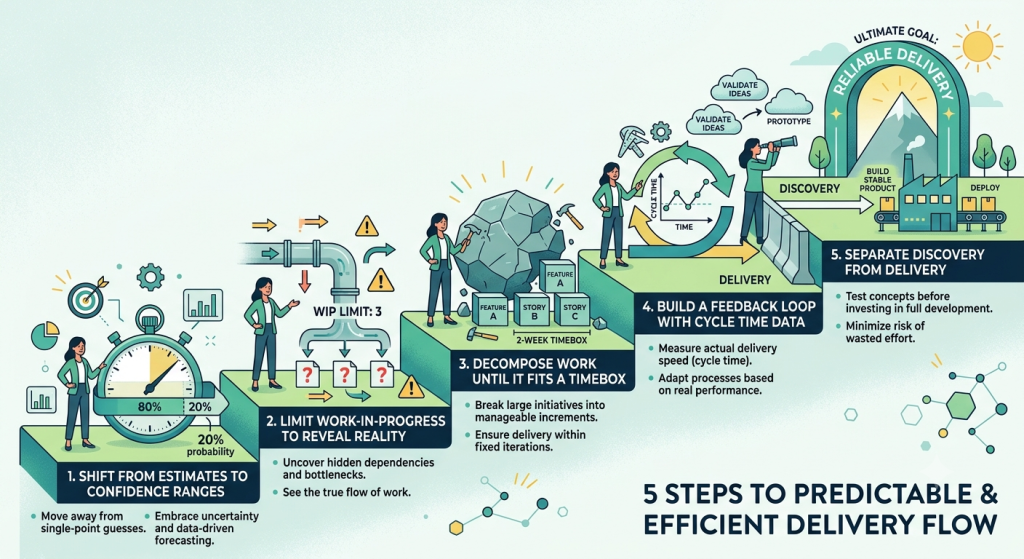
1. Shift from Estimates to Confidence Ranges
One of the most persistent myths in software development planning is that precise hour-based estimates are possible. They are not. What is possible and far more useful in expressing work in confidence ranges.
Wrong approach: “This feature will take 3 days.”
Right approach: “We’re 90% confident this feature will take between 2 and 5 days.”
This isn’t just semantics. Point estimates create false precision, which leads to missed deadlines, eroded trust, and reactive replanning. Ranges communicate honest uncertainty and give stakeholders a realistic picture of delivery windows.
How to build confidence ranges
- Use t-shirt sizing (S, M, L, XL) when initially scoping backlog items
- Track actual cycle times per size category across 3–4 sprints
- After enough data, your “medium” tasks will reveal their real range often 4–7 days, not the 3 you assumed
- Report to stakeholders in ranges, not points; save point estimates for internal team conversations only
The discipline here is consistency. Once you measure long enough, patterns emerge and those patterns become your planning engine
2. Limit Work-in-Progress to Reveal Reality
Most delivery variability doesn’t come from bad code. It comes from multitasking. A developer juggling three active tickets isn’t three times more productive they’re cycling three times slower, and every context switch burns cognitive overhead.
As Don Reinertsen, author of The Principles of Product Development Flow, puts it: “People being fully utilised is not an efficiency measurement; it’s a queueing nightmare.”
What to do
- Set explicit WIP limits per developer (a common starting point: no more than 2 active tickets at once)
- Create a clearly labelled “Doing” column on your Kanban or Scrum board not a vague “In Progress” bucket
- Enforce a policy: when WIP capacity is full, nothing new starts until something ships
Why it works
WIP limits make problems visible immediately. A blocked ticket can no longer hide behind a crowded board. Cycle times stabilise. And because work flows predictably through the system, forecasting becomes far more accurate you’re predicting a constant stream, not a chaotic flood.
3. Decompose Work Until It Fits a Timebox
Unpredictability thrives in large, vague tasks. “Build the checkout module” is a project disguised as a ticket. “Add email validation to the checkout form” is an actionable, deliverable task.
A reliable rule of thumb for software development planning: if a task cannot be completed within your team’s smallest timebox (typically one day or four hours), it’s not a task it’s a project. Break it down further.
Three effective decomposition techniques
Functional slices Instead of building “database layer + API + UI” as separate tasks, carve a thin, end-to-end slice: “User can view a product page.” Each slice delivers real user value and can be tested independently.
Spikes When you don’t yet know how to build something, don’t estimate it. Create a timeboxed research spike (2–4 hours). The output is knowledge and a decision, not production code.
Vertical slices Always prefer a thin, working slice of user value over a thick, unfinished architectural layer. A skeleton that works end-to-end is always more valuable than a beautifully built component that can’t be tested in context.
Small, well-decomposed tasks also reduce review cycles, shorten feedback loops, and dramatically improve daily standup quality.
4. Build a Feedback Loop With Cycle Time Data
The most underused software development planning tool isn’t a framework or a methodology. It’s your own historical data. Cycle time (the duration from when work starts to when it’s done) is the most honest signal your delivery system produces.
What to track
- Cycle time per ticket, per size category, per developer
- Throughput: how many tickets does your team complete per week?
- Lead time: from the moment a stakeholder requests something, how long until it’s live?
Once you have 6–8 weeks of data, you can build probabilistic forecasts. Instead of asking “when will this be done?” you ask: “Given our throughput history, what’s the 85th percentile completion date for this set of work?”
Tools like LinearB, Nave, or even a well-maintained spreadsheet can surface this data. The key is consistent measurement not occasional heroics.
5. Separate Discovery from Delivery
A major cause of unpredictable delivery is conflating figuring out what to build with actually building it. When discovery and delivery happen simultaneously, both suffer.
Discovery work : user research, design explorations, technical spikes, stakeholder alignment is inherently unpredictable. Delivery work, once the scope is clear, can and should be highly predictable.
How to separate them
- Run a lightweight discovery phase (sometimes called a “Shape Up” cycle or a “pre-sprint”) before any feature enters development
- Nothing enters the delivery backlog until it has a clear, scoped brief: defined acceptance criteria, decomposed tasks, and identified dependencies
- Treat “I don’t know how to build this yet” as a discovery task, not a delivery task
Teams that separate these phases consistently outperform those that don’t. Developers spend less time in ambiguity. Stakeholders get cleaner estimates. And delivery becomes genuinely predictable rather than aspirationally so.
Final Thoughts: Predictability Is a System, Not a Skill
The teams that achieve predictable software development planning aren’t more talented. They’ve designed better systems. They measure what matters, constrain work-in-progress, communicate honestly in ranges, and keep discovery separate from delivery.
Start with one change. Add WIP limits this sprint. Switch to confidence ranges in your next planning session. Track cycle times for a month. Each small shift compounds. Over time, the chaos becomes a flow and your stakeholders will notice.
Want to go deeper? Explore related articles on Agile estimation techniques, Kanban flow metrics, and how to run effective sprint retrospectives.