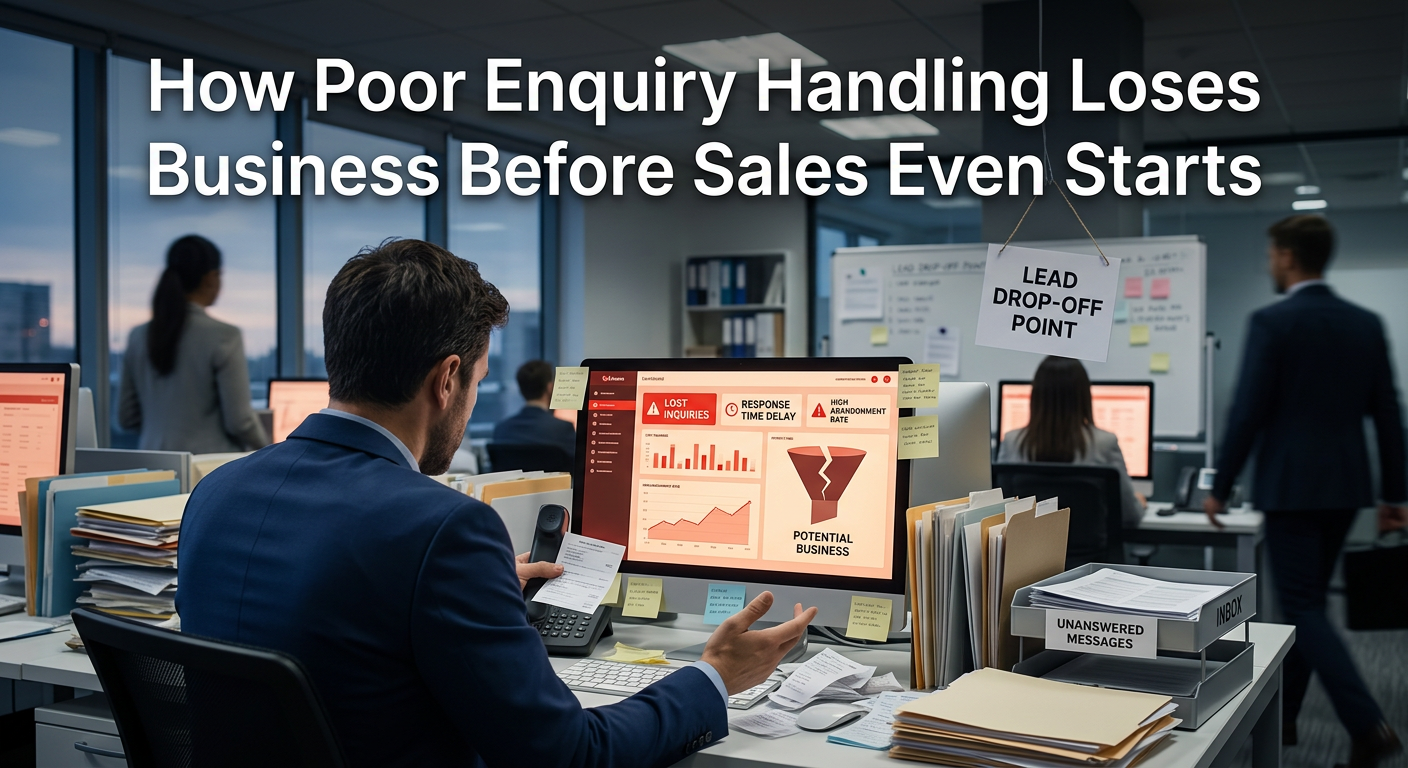
Most SMEs lose deals they never knew they had.
Not because the offer was weak.
Not because the market was not interested.
But because something went wrong in the gap between “enquiry received” and “someone actually replied.”
Why This Problem Gets Missed
For many founder-led businesses, enquiry handling is treated as a basic admin step.
A customer fills in a form, sends an email or gets in touch through the website, and the assumption is that someone will see it and respond. On the surface, that sounds reasonable.
In practice, this is often where avoidable lead loss begins.
An enquiry arrives during a busy period. It lands in a shared inbox. One person assumes someone else has seen it. Another plans to reply later. The message gets buried under more urgent tasks.
By the time someone responds, the prospect has already moved on.
Why Enquiry Handling Is Really a Sales Problem
This is not just an admin issue, weak enquiry handling is an early-stage sales problem
The business has already done the hard part. It has created visibility, earned interest and persuaded someone to make contact. That should be one of the easiest opportunities to handle well.
But if the process behind the enquiry is weak, the lead can be lost before any real sales conversation even begins.
That means potential business disappears quietly, without always being recognised as a lost opportunity.
The Cheapest Win Many SMEs Overlook
The encouraging part is that this is often one of the cheapest problems to improve.
Fixing enquiry handling rarely needs more staff, it usually needs a better flow
It usually needs a better flow.
A stronger enquiry process helps the business respond faster and more consistently without depending on people simply working harder or trying to remember more.
What a Better Enquiry Flow Should Do
A good enquiry flow is not complicated.
It should do a few simple things reliably:
- acknowledge the enquiry quickly
- route it to the right person
- store it somewhere it cannot be lost
- create visibility for the team
- trigger follow-up if no one has responded in time
Without those steps, enquiry handling becomes dependent on inboxes, memory and good intentions — a fragile mix at best.
That creates unnecessary risk.
What Poor Enquiry Handling Actually Costs
The first cost is speed.
This isn’t just anecdotal, research on lead response times shows that leads contacted within the first hour are far more likely to convert than those left waiting, and response speed continues to decay sharply after that.”
Many customers do not wait long, especially if they are contacting several businesses at once. A slow response does not just delay the conversation. It shapes how reliable the business appears.
The second cost is consistency.
If one enquiry gets answered in ten minutes and another waits two days, the process is not dependable. It is based on chance.
The third cost is visibility.
Founders and managers often cannot clearly see what has arrived, who owns it, how quickly it was handled or what still needs action. That makes it harder to improve performance and easier for leads to disappear unnoticed.
Why More Marketing Is Not Always the Answer
Many SMEs focus on generating more enquiries before fixing what happens after someone gets in touch.
That creates a common problem.
The business invests in visibility, website traffic or outreach, but the process behind incoming demand is still fragile. More leads come in, yet too many are handled slowly, inconsistently or not at all.
There is little value in creating more enquiries if the enquiry flow is weak from the start.
What to Review First
Improving enquiry handling does not always require a large system.
Often, it starts with simple questions:
- Where do enquiries currently arrive?
- Who sees them first?
- How quickly is the customer acknowledged?
- How is ownership assigned?
- Where is the enquiry stored?
- What happens if nobody responds?
Those questions usually reveal whether the process is reliable or whether it depends too heavily on people noticing, remembering and manually passing things on.
Final Thought
An enquiry should not rely on luck.
It should move through a process, the same principle behind why your website should be more than a brochure.
For SMEs, this is one of the most practical operational improvements available. It protects demand the business is already generating, reduces avoidable lead loss and helps the team respond more consistently.
If your business relies on emails being noticed and remembered, the issue may not be effort. It may be your enquiry handling process.