The world of web development is undergoing a remarkable transformation. As we move beyond traditional approaches, innovative technologies and methodologies are reshaping how we build, deploy, and interact with web applications. This new approach to web technologies emphasizes performance, user experience, and developer productivity like never before.
Modern web technologies are breaking down barriers between native and web applications, offering experiences that are fast, reliable, and engaging across all devices. From progressive web apps to serverless architectures, the landscape is evolving at an unprecedented pace.
Contemporary web technologies are eliminating the distinctions between native and web applications, providing fast, dependable, and captivating experiences on every device. With the rise of progressive web apps and serverless architectures, the industry is transforming more rapidly than ever before.
AI and Machine Learning: The New Web Intelligence Layer
Artificial Intelligence is no longer a futuristic concept but a fundamental component of modern web development, operating on dual fronts: enhancing developer capabilities and creating adaptive user experiences.
- AI-Powered Development Tools like GitHub Copilot and AI-driven debugging assistants are revolutionizing development workflows. These tools accelerate coding, automate testing, and even suggest architectural patterns, significantly reducing development cycles and allowing teams to focus on innovation rather than implementation details.
- Intelligent User Experiences represent perhaps the most visible transformation. Modern websites leverage machine learning algorithms to analyze user behavior in real-time, delivering personalized content streams, predictive recommendations, and contextual interfaces. AI-powered chatbots have evolved from simple scripted responders to sophisticated conversational agents capable of handling complex customer service interactions, product guidance, and even therapeutic conversations.
Performance and Architectural Revolution
The demand for seamless, instantaneous web experiences has driven fundamental shifts in how we architect and deliver web applications.
- Serverless Architecture has liberated developers from infrastructure management, enabling true focus on business logic. By abstracting servers, scaling becomes automatic, costs align directly with usage, and deployment cycles accelerate dramatically. This paradigm shift supports the unpredictable traffic patterns of modern applications while optimizing operational expenses.
- Micro-Frontends bring the microservices philosophy to the client side, decomposing monolithic front-end applications into independently developed, deployed, and scaled feature modules. This approach enables large engineering organizations to move faster, adopt diverse technology stacks within a single application, and improve overall maintainability and team autonomy.
- WebAssembly (Wasm) represents a quantum leap in browser capabilities. By enabling near-native execution of code written in languages like Rust, C++, and Go, Wasm unlocks previously impossible browser applications: professional-grade video editing software, complex CAD tools, scientific simulations, and high-performance games all running securely within the browser sandbox.
Emerging Interaction Paradigms
The boundaries between digital and physical experiences continue to blur as new interaction models emerge.
- Web 3.0 and Blockchain Integration marks a philosophical shift toward user sovereignty. Decentralized applications (dApps) built on blockchain technology offer new models for digital ownership, transparent transactions, and user-controlled identity. While still evolving, this movement challenges traditional centralized web architectures and introduces novel approaches to trust, verification, and value exchange.
- Progressive Web Apps (PWAs) have matured from concept to mainstream solution, bridging the gap between web and native mobile experiences. With capabilities like offline functionality, push notifications, and home screen installation, PWAs deliver app-like experiences with the reach and accessibility of the web. This approach is particularly transformative for markets with connectivity challenges or for businesses seeking to reduce mobile development costs.
- Immersive Experiences are redefining user engagement. WebXR APIs now enable sophisticated augmented and virtual reality experiences directly in browsers, from virtual product try-ons in e-commerce to interactive educational simulations. Combined with accelerated 3D graphics capabilities, these technologies create spatial web experiences that blend digital content with physical environments.
- Voice-First Interfaces are becoming increasingly important as smart speakers and voice assistants proliferate. Modern web development now considers voice as a primary interaction mode, optimizing for natural language queries, hands-free navigation, and audio-first content delivery. This shift not only enhances accessibility but creates more natural, human-centric interaction patterns.
The Convergence Effect
The true power of these technologies emerges through their convergence:
- AI + Micro-Frontends enables intelligent, self-optimizing application modules that adapt based on user behavior and performance metrics
- Serverless + WebAssembly creates high-performance, instantly scalable applications without infrastructure overhead
- Blockchain + PWAs offers decentralized, installable applications with user-controlled data
- WebXR + AI delivers intelligent, context-aware immersive experiences
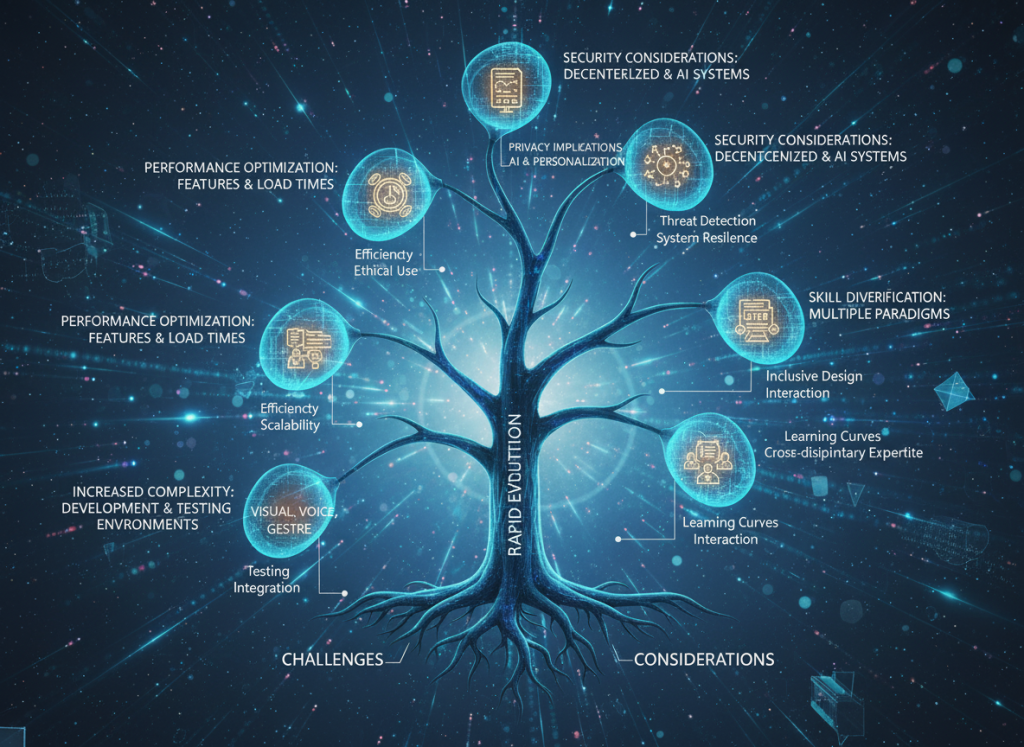
The Future Web Development Stack
Tomorrow’s web developer operates across a expanded stack that includes:
- AI co-pilots for development assistance
- Edge computing platforms for distributed execution
- Blockchain integrations for decentralized features
- Immersive experience frameworks for 3D/AR/VR
- Voice interaction layers for multimodal interfaces
- Performance monitoring AI that predicts and prevents issues
The “new approach” to web development represents a fundamental shift from creating static digital brochures to engineering intelligent, adaptive experiences that respond to individual users, context, and intent. As these technologies mature and converge, they promise to create a web that is not only faster and more capable but also more intuitive, personalized, and human-centered than ever before.
The organizations and developers who embrace this holistic perspective, understanding not just individual technologies but their synergistic potential, will define the next generation of web experiences. The future web will be less about what we build and more about what we enable: seamless, intelligent, and deeply meaningful interactions that extend human capability rather than simply presenting digital information.